

Integration in Motion:
From Core To Whole Self

For most of my early life, I thought of training the body in parts. An ankle to strengthen here, a shoulder to improve there, a stubborn hip that did not do what choreography demanded. During my first forays into anatomy at university, my only interest was looking at the dissected cadavers in front of me to actually SEE, touch, and feel how body parts moved together, so I could figure out how to get my leg up by my ear in an extension or arabesque. It took years of dance and other physical activities - and injuries, and more study - to recognize that what I was really chasing was not just stronger muscles. It was relationships. I was looking for integration in movement, the capacity of my whole system to organize itself in motion, moment by moment, in real time.
When I say integration in movement, I’m not simply talking about engaging your abdominals or switching on your glutes. I’m talking about how your whole system - body, brain and nervous system - coordinate so you can move with clarity, power and ease, whether you are hiking, skinning up in the backcountry, or getting down on the floor to play with your kids.
For the purposes of this discussion, I'd like to explore three layers of integration in movement.
First: The idea of core integration with movement, not just the activation of individual muscles.
Second: Movement literacy. How can Pilates and daily activity teach us the ABCs of movement?
Third: Integrating self - bringing our awareness to relationships between mind, body and spirit through the lens of the nervous system.

I like to think of integration in movement like the butterfly effect in a living ecosystem. No single wingbeat creates the weather, yet every tiny movement contributes to the patterns we experience as storm or calm. In much the same way, no single muscle, joint, belief or habit defines us; but together they shape how we stand, move, feel and relate to the world around us. When we start to see ourselves as more than the sum of our parts, it becomes easier to recognize that the way we move is both shaped by, and shaping, everything else in our lives.
Core integration in movement: beyond strong abdominals

In rehab, performance training, and fitness media, the core often gets reduced to talk about the six pack. In Pilates, you'll often hear about the "powerhouse." But let's be clear - the core IS NOT just your abdominal muscles.
Clinically and biomechanically, the core is typically considered to be the deep and superficial muscles of the trunk and hips that surround and support the spine and pelvic organs. These muscles help us manage load and transmit force between the upper and lower body in everyday movement. When those systems are integrated well into movement, they provide stability that is dynamic and adaptable, not rigid.
Research in physiotherapy, and strength and conditioning suggests that when we progress from isolated activation to more global tasks that involve the trunk working with the shoulders and hips, we may challenge coordination and muscle recruitment in ways that better resemble real life demands. This is true whether we are training for mountain biking, hiking, sitting at a desk or simply moving around in our lives.
In a Pilates workout, we might experience core integration in movement when we:
- Transition load during legwork dynamically - from one leg to another for example - so the deep system responds as we shift, not just when we stabilize statically.
- Lunge with an arm reach at the Cadillac, which asks the trunk to organize between the foot on the floor, the pelvis and spine travelling forward in space, and the hands in the springs.
- Play with a spiral pattern on the mat, during telescoping arms or the corkscrew on the mat for example, where breath, ribcage, pelvis and eyes may all participate in the twist.
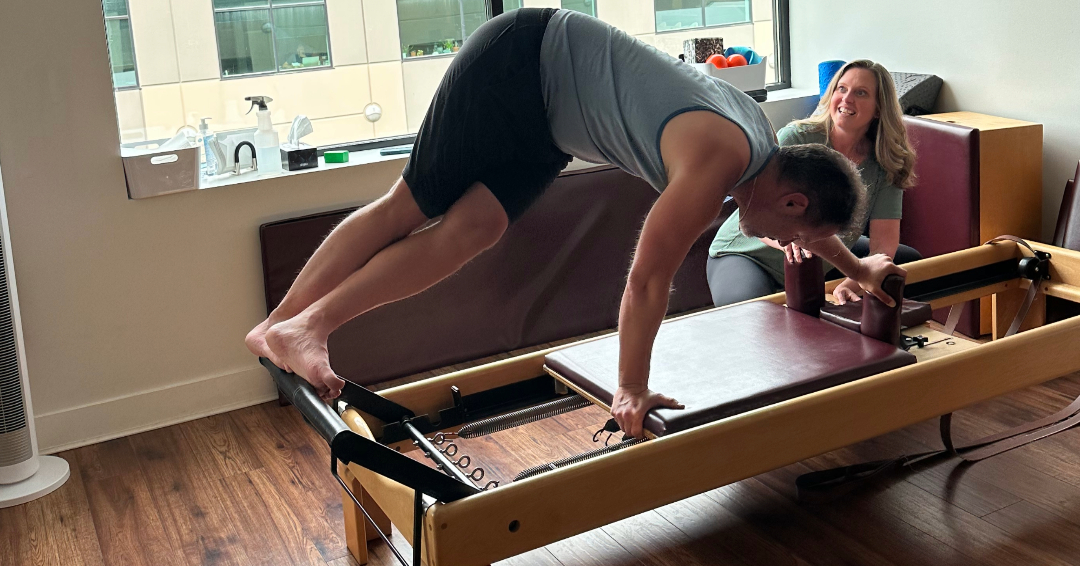
In the practice of the movement, we can observe whether we feel the core as a connector rather than a clamp. Does the movement feel fluid or braced? We can learn to sense force traveling through us rather than feeling like we are muscling each part separately.
If we catch ourselves gripping, holding our breath, or overdoing a specific cue - our sensation can be useful data. Integration in movement often feels like “enough.” Or maybe just “right” somehow. There is a clear, responsive engagement, not maximal effort in every moment.
Movement literacy: bringing Pilates into daily life
I often think of Pilates as a language of movement. Like learning to read, we first learn letters, then words, then stories. In movement science this idea is close to what is called physical literacy or movement literacy. It is the ability to move with competence and confidence in a wide variety of contexts through fundamental human movements such as locomotion, hinging, squatting, pushing, pulling, rotating and resisting rotation.

Pilates can be like a laboratory in which we can explore elements of movement literacy in a controlled environment. We can deconstruct and then reconstruct movements that show up everywhere in daily life, or in whatever physical activity we want to get curious about. (When we get sciency about it - we call these “meaningful tasks.”)
A squat pattern shows up as getting in and out of a chair, loading the dishwasher or dropping into a trail running descent. A hip hinge appears when we lift a garbage bin, or maybe pick up a paddle board. Rotation and anti-rotation are at play every time we swing a golf club, walk the dog or carry groceries on one side.
In the studio we can slow down and notice which parts of the pattern seem clear and which parts feel fuzzy. Do we know where our weight is in our feet? Can we feel the pelvis glide over the heads of the femurs or does the low back dominate? Are the ribs moving with the breath or staying locked? If you practice Pilates, you’ve probably heard your teachers ask these very questions. They are an important part of building awareness and integration.

Transferring the movement literacy we discover in Pilates into our daily lives is where integration in movement really pays off. If we practice with attention we might find that the way we step over a muddy root on a hike mirrors the lunge patterns we have explored in class. Our spine rotation while checking a blind spot might feel more like a smooth, segmental twist than an all or nothing neck crank. We may spontaneously choose different options, such as a hip hinge instead of a rounded back bend, because our system has more integrated patterns available.
Physical literacy researchers emphasize that this adaptability, having a rich repertoire of coordinated patterns we can draw on, helps lower the chance of getting hurt and makes it easier to stay active through all our years. For those of us who want to keep skiing, paddling, dancing and hiking for decades, movement literacy and integration in movement are not luxuries. They are essential. (Check out this article I wrote several years ago on the subject: "How Are Your Movement ABC's: Movement Literacy, Essential for Life!")

One of the things I love most about Pilates is that it offers us a way to explore movement skills in a variety of different ways, on different equipment, with different orientations to gravity and load demand throughout the Pilates program, or through the span of a training arc. We can practice the same basic skill lying on our back, on our front, or upside down - giving us different feedback around the same movement. The apparatus gives us the ability to load the body lightly, or heavily, on one side, from above, from below… literally any load orientation we can imagine. The variability allows us to learn the movement in our bodies in a whole host of controlled “environments.”
When we can expand our “lab environment” to include other activities, beyond Pilates, we can amplify our ability to integrate these skills into our daily lives. If you’re someone who gets excited about the details of your movement, you can get really granular about it and explore specific aspects of your squat when you’re riding your bike, for example. Or if you just like the way it feels when your body is well organized, you might ask which of the Pilates principles is present in what you are doing right now? You might get curious about your concentration, your control, how you are experiencing your center, how precise or fluid your movement feels, or noticing how you are breathing. (Are you breathing?) A simple inquiry like this can start to dissolve the boundary between class and real life.
The nervous system, mind, body and spirit in motion
Integration in movement is not just mechanical. Over the span of my career, I’ve observed how people’s emotional lives, sense of self and nervous systems show up in how they move. Modern neuroscience is catching up with what somatic practitioners have said for a long time. The mind body connection is literally built into the structure of the brain.

Recent imaging studies show that motor areas of the brain, regions controlling voluntary movement, are directly connected to networks involved in cognition, planning and autonomic regulation such as heart rate and blood pressure. When we move we are not just working muscles. We are influencing attention, mood and the state of our nervous system. Integration in movement always includes integration of the nervous system. You may have experienced this yourself after dragging yourself into the Pilates studio at the end of a long day, and after your workout, you leave feeling somehow just better. Maybe even more like yourself.
Movement therapy and dance movement psychotherapy research highlight that embodied movement practices can support emotional regulation, trauma processing and resilience by giving people a safe, structured way to sense, express and organize their internal states.
In a Pilates or integrated movement session we can intentionally work with this layer of integration by tracking arousal and observing when a challenge spikes our heart rate, breath or muscle tension. We can experiment with pacing, breath or load to keep the system in a workable zone. We can also include pauses, using small rests, gentle rocking or breath focused positions to allow the nervous system to digest the work instead of pushing through on willpower alone.
Honouring agency is another key part of integration in movement and nervous system health. When we offer choices, such as whether to explore a pattern on the Reformer or on the mat, the system learns that movement can be a place of consent and collaboration, not just compliance. Practitioners in somatic and movement based therapies emphasize that this kind of nervous system aware practice helps integrate mind, body and what many call spirit, our sense of meaning, connection and our why for moving at all.
When movement becomes a place where we can listen to ourselves, not only perform, we often find that aches soften, breath deepens and a sense of internal alignment emerges. This alignment has very little to do with perfect posture and a lot to do with feeling at home in our own skin.
Practicing integration in movement
What might integration in movement look like for us - here and now? These are some possible ways to extend the “movement integration lab” into our Pilates practice, and into our own lives beyond the studio:
- Choose at least one daily activity, such as walking the dog, climbing stairs or loading the car, as a deliberate practice ground for core integration in movement. Notice how the trunk responds as legs and arms move.
- Pick one movement theme for the week, like a hinge or some rotation, and notice where you find it in Pilates, in sport and in those pesky daily chores.
- Take thirty seconds before and after practice to sense the nervous system. Ask how we are arriving and how we are leaving; not to judge, but to get curious about how movement is shaping our inner landscape.
When we can explore our movement this way, we are not just checking boxes on a workout plan. We are building a strong, stable, resilient and integrated system. We are growing a body that can respond to the trails, slopes, water and relationships we love, a brain that can focus and adapt, and a spirit that feels connected to something larger than a single class or performance.
My hope is that, with a little mindful and consistent practice, we can each name a few specific ways we feel more integrated in movement. It might be a steadier stride on the trail, a clearer sense of our center in a tricky balance, or a deeper trust in our body’s capacity to support the life we want to live.

#itsaboutmorethanjustmuscles
______________________________________________________________________________
Susannah Steers is a Pilates and Integrated Movement Specialist, and the founder of Moving Spirit Pilates in North Vancouver, BC. She helps people discover strength, freedom, and confidence through better movement. Alongside her studio teaching, Susannah is a sought-after speaker, workshop facilitator, writer, and podcast host — always exploring fresh perspectives on how movement can inspire health, resilience, and meaningful connection.